
Tree Care 101: What Your New Tree Needs In Its First Year.
Caring for Newly Planted Trees If you’ve just had a new tree planted on your property, you’re probably very excited! You selected just the right species to provide shade, or beautiful flowers, or to form a nice boundary marker. You carefully chose a location for it, and our crew came by and installed the tree…
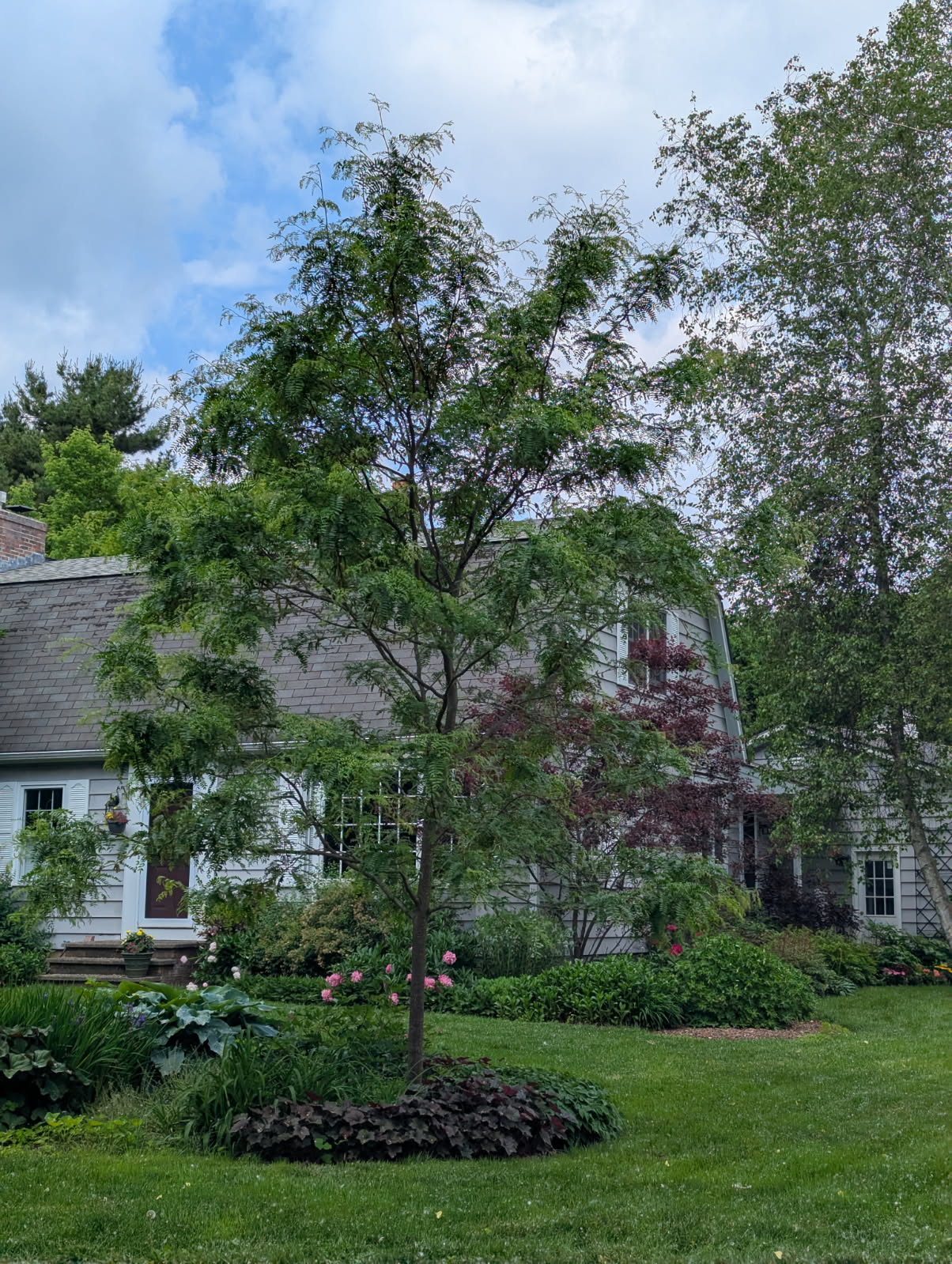
Caring for Newly Planted Trees
If you’ve just had a new tree planted on your property, you’re probably very excited! You selected just the right species to provide shade, or beautiful flowers, or to form a nice boundary marker. You carefully chose a location for it, and our crew came by and installed the tree for you. But now that they’ve packed up and left, what should you do? How should you keep your young tree healthy? There are some simple steps you can take to ensure that your new tree grows strong, healthy, and remains that way for decades.

Staking
Staking is usually not needed for new trees. However, if your tree is top-heavy, or growing in an exposed, windy area, then staking may be a necessary precaution to prevent it from blowing over. If our crew installed stakes when we planted your trees(s), remove the stakes and ties once the roots are able to support the tree on its own, typically within one year of the planting. Leaving a tree staked too long can lead to injury by the staking lines abrading the bark or girdling the stem.
Watering
The most important step in taking care of your new tree is to keep it properly watered. Knowing when to water your tree can be tricky; there are guidelines you can follow, but each tree is a little bit different. Carefully observe how it changes and adjust your watering schedule as needed. Generally, young trees need anywhere from 4-10 gallons of water per week. Check the soil moisture two inches below the surface; if it’s soggy, it probably doesn’t need more water. But if it feels dry, it’s time to pull the hose out. When you water your tree, do it slowly; put the hose on a trickle and let it sit underneath the tree for 15 minutes at a time. This makes sure that the water soaks deep into the soil, where the roots are. Consider putting a tree watering bag around the trunk, which can be filled quickly with a known volume of water, and then disperses the water over a longer period of time. The frequency of watering matters, too – your new tree should be watered every three to five days, more frequently when the temperature is above 75⁰F.
In the fall, sometimes less watering is needed. Use caution, as young trees can still dry out easily even if the weather is no longer scorching hot. You should keep an eye on how dry the soil is and continue watering as needed until the temperature is below freezing.
Fertilizing
Newly planted trees usually don’t need to be fertilized right away. In most cases, there are enough nutrients in the soil for the tree to establish itself and start growing larger. However, if your tree hasn’t shown signs of growth after its first few years, fertilizing could be the solution. Trees compete with the other plants around them for iron, magnesium, phosphorus, and other elements. In many cases, those nutrients are taken up by turf grasses or garden plants before the tree can reach them. In addition, we often remove leaves and dead branches from our property, which would otherwise decompose and replenish the nutrients in the soil. Amending the soil with deep-root fertilization can help boost a stalling tree’s growth.
Pruning
Pruning your new tree is also generally not recommended. Transplant shock is caused when a plant is uprooted and replanted, and pruning can make the symptoms worse – potentially even killing the tree. You may cut out damaged or defective branches, as these could allow diseases to enter the tree, but otherwise it’s best to wait 2-3 years before doing any additional pruning. Once it has established itself, you can begin making structural pruning cuts; structural pruning helps ensure that the tree grows a straight, strong trunk, without defects or competing leaders, which could worsen over time and eventually cause parts to break off dangerously. Remember to never remove more than 15% of a small tree’s crown at one time, and try to retain most of the lower branches if possible – research shows that lower branched improve trunk size and strength. If you are unsure of how to make structural prunes, our trained arborists can assist you.
Finally, our crew will create a mulch ring around your tree. It may be tempting to add more for aesthetic purposes, but “mulch volcanoes” are harmful to the tree’s health. Excessive mulch can restrict oxygen to the roots and cause the bark to decay. Mulch does need to be slowly replenished over time, but trees usually don’t need more than 1 additional inch per year.
Sources
Struve, Daniel K. 2009. “Tree Establishment: A Review of Some of the Factors Affecting Transplant Survival and Establishment.” Arboriculture & Urban Forestry 35(1): 10-13.
https://yardandgarden.extension.iastate.edu/how-to/care-newly-planted-trees
https://www.dnr.state.mn.us/treecare/caring-pruning.html
https://treetrust.org/how-to-plant-a-tree/ – esp for image of planted tree
Greg Ranallo
From the classroom to the trees
Greg Ranallo has been working with trees since he was 19 years old — a passion that began long before it became a profession. After earning a master's degree in education and teaching high school social studies in his native Minnesota, Greg ultimately followed the calling he'd had since boyhood and built Teacher's Tree Service into one of the Champlain Valley's most trusted arboriculture companies. As he puts it, "I was always more a tree guy who was teaching than a teacher who did tree work."
Our Articles
Why Won’t My Shrub Lose Its Leaves in Vermont?
When a shrub won't lose its leaves while the rest of your Vermont yard goes bare, it's usually invasive buckthorn or honeysuckle. Here's how to tell which.
Is Fall a Good Time to Plant a Tree in Vermont?
Wondering if fall is too late to plant a tree in Vermont? See the local frost timeline, best species picks, and the mistakes that kill new trees.
How Can You Tell If a Tree Is Dangerous?
Worried a tree could fall on your property? Learn the warning signs Vermont arborists check first—and when to book a hazard assessment in Chittenden County.
