
How to Identify, Treat, and Prevent Spongy Moth in Vermont
Spongy moth stripped 50,000+ acres of trees in Vermont in 2021. Know the signs, the treatment window & when to call an arborist before the next outbreak hits.
If you drove through Burlington, Shelburne, or Charlotte in June 2021, you saw it: thousands of trees stripped nearly bare, caterpillar frass raining from the canopy, and egg masses plastered on everything from mailboxes to car bumpers. Vermont’s spongy moth outbreak defoliated more than 50,000 acres of trees across the Champlain Valley before wet weather collapsed the population in 2023.
While most homeowners have moved on, the caterpillars haven’t. Spongy moth outbreaks in Vermont are cyclical, and all it takes to trigger the next one is a drought. Understanding how to identify spongy moth at every life stage, which trees are most at risk, and when professional treatment makes the difference helps you identify a tree that will recover and one that won’t when the cycle inevitably comes around again.
Key Takeaways
- Spongy moth caterpillars prefer oaks, maples, and birch — all common in Vermont yards — and can strip a tree bare in a heavy outbreak year.
- Most healthy hardwoods can survive one year of defoliation, but repeated defoliation can lead to decline and death.
- Conifers are more vulnerable, and a single season of heavy defoliation can be fatal.
- BTK (Bacillus thuringiensis var. kurstaki) spray only works on small caterpillars in May through early June — missing that window means you need professional trunk or soil injection treatments.
- An ISA Certified Arborist can assess your trees’ risk level and recommend a management plan tailored specifically to your property.
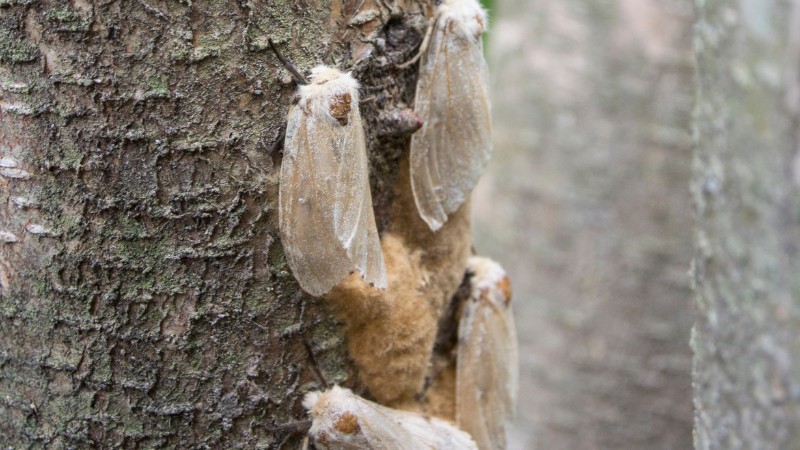
Female spongy moths gather near a freshly laid egg mass. Each mass can contain 500 to over 1,000 eggs that will hatch the following spring.
What Is a Spongy Moth?
Established in Vermont for over a century, spongy moth (Lymantria dispar) is an invasive caterpillar that strips leaves from more than 300 tree and shrub species. During outbreak years, caterpillars can completely defoliate a mature tree within weeks, forcing it to burn through stored energy to push a second flush of leaves mid-summer.
One year of that is stressful. Two or three years in a row, especially during drought, can kill the tree. Here’s what to look for at each stage of its lifecycle:
How to Identify Spongy Moth Egg Masses
Spongy moth egg masses are buff or tan fuzzy patches, roughly 1.5 inches long, that look like a piece of felt glued to a surface. You’ll find them on tree trunks, branches, outdoor furniture, firewood stacks, vehicles, and play structures. Each mass contains 500 to over 1,000 eggs.
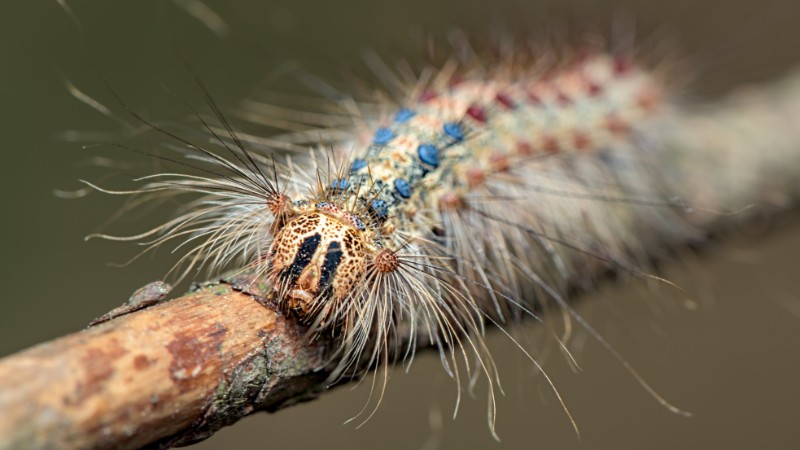
The blue and red dot pattern along the back is the definitive way to identify a spongy moth caterpillar — and to distinguish it from eastern tent caterpillars.
How to Identify Spongy Moth Caterpillars
Reaching a mature size of 1.5 to 2.5 inches, spongy moth caterpillars are identified by their hairy appearance with five pairs of blue dots followed by six pairs of red dots running down the back. Of all the life stages, this is the one that causes the greatest harm to trees.
The caterpillars feed mostly at night and hide in bark crevices during the day, so heavy infestations often go unnoticed until defoliation is already underway. If you do spot them and plan to remove them, wear gloves — their hairs can cause skin irritation.
Adult Spongy Moths: Male vs. Female
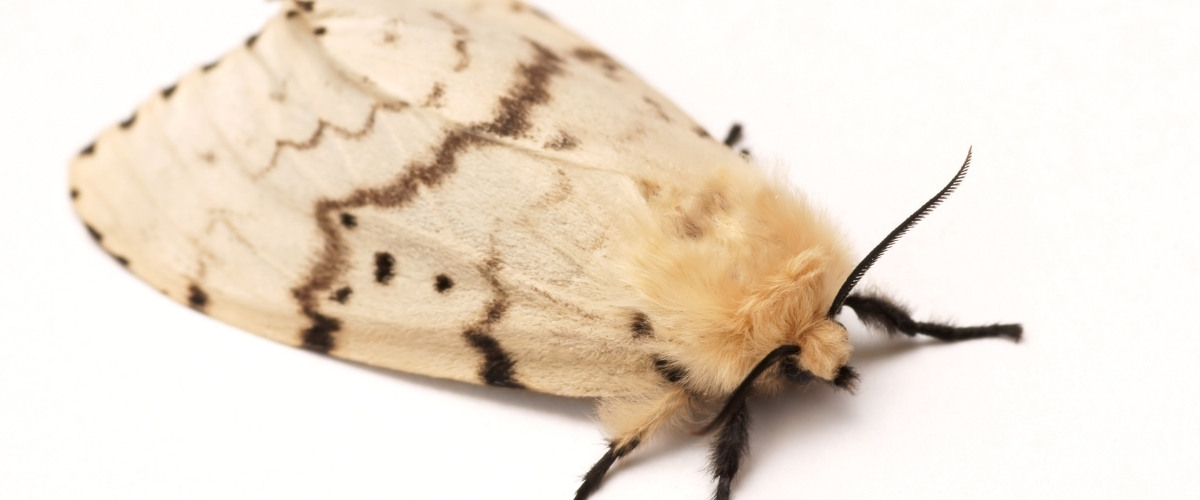
Male spongy moths are brown with a roughly 1.5-inch wingspan and can fly. Females are white to cream-colored, larger (about 2.5-inch wingspan), and cannot fly. Females lay their egg masses on nearby surfaces shortly after mating, restarting the cycle.
Which Trees Do Spongy Moths Attack in Vermont?
Spongy moth feeds on more than 300 species, but some of the trees most commonly found in Chittenden County yards are also its preferred targets:
- Oaks: red oak, white oak, bur oak
- Sugar maples
- Birch: paper birch, yellow birch
- Apple trees
- Poplar
- Willow
- Basswood
- Hawthorn
DID YOU KNOW? Conifers, like spruce, fir, and pine, are actually more vulnerable to spongy moth destruction than hardwoods. A single season of heavy defoliation can kill a conifer outright, while a healthy hardwood will typically push a second flush of leaves by mid-summer. If you have conifers on your property, they should be your first priority for monitoring and treatment.
When Are Spongy Moths Active in Vermont?
Spongy moths follow a predictable annual cycle, and knowing what to look for each season is the key to protecting your trees before damage is done:
| Season | What to Watch For | Recommended Action |
|---|---|---|
| Fall (Sept. – Nov.) | Female moths lay egg masses on tree trunks, outdoor furniture, firewood, and vehicles. | Have your arborist assess infestation levels and plan a treatment strategy for spring. Scrape any egg masses you find into soapy water. |
| Winter (Dec. – March) | Egg masses remain dormant and visible on surfaces. | Continue scouting and removing egg masses. Schedule spring treatment with your arborist before the busy season. |
| Spring (May – Early June) | Caterpillars hatch and begin feeding on leaves. This is the critical treatment window. | Contact your arborist immediately. BTK — a naturally derived biological insecticide that targets caterpillars without harming beneficial insects — is most effective now while larvae are small. Systemic treatments are also an option. |
| Summer (June – Aug.) | Defoliation visible in the canopy. Pupae and adult moths appear. | Deep water stressed trees at the drip line (~1 inch per week). An arborist can evaluate tree health and recommend recovery treatments including fertilization. |
The spring window is the most time-sensitive. BTK is only effective on small caterpillars — roughly .5 to 3/4 of an inch long — and becomes useless after mid-June. Miss that window, and professional trunk or soil injection treatments are the only remaining options.
PRO TIP: Don’t wait until you see defoliation to call. By then, the best treatment window has often passed. Late winter is the ideal time to schedule a spring treatment plan.
How Do Arborists Treat Spongy Moth?
Arborists treat spongy moth with BTK foliar spray, trunk injection, or soil injection — professional methods that are necessary because caterpillars feed high in the tree canopy, where homeowner equipment can’t reach.
Since Vermont doesn’t conduct state aerial spray programs, protecting your trees is up to you. Here’s what a professional arborist can do:
- BTK Foliar Spray: Professional-grade application achieves full canopy coverage that consumer equipment can’t match. Timed to the narrow May – early June window when caterpillars are small and actively feeding.
- Trunk Injection: A systemic insecticide delivered directly into the tree’s vascular system. It’s targeted, produces no spray drift, and provides longer-lasting protection. Must be applied by a licensed pesticide applicator.
- Soil Injection: A professional treatment applied to the root zone, ideal when foliar sprays aren’t practical or when systemic uptake is preferred.
Treatment works best as part of an overall plant health care strategy. Trees that are properly watered, growing in healthy soil, and maintained with regular pruning are far more likely to withstand defoliation and bounce back.
When Should You Call an Arborist About Spongy Moth?
Not every spongy moth sighting warrants professional treatment — but several situations do:
- Your Trees Are Over 15–20 Feet Tall: You can’t achieve effective canopy coverage with homeowner spray equipment. Professional application is the only way to protect large trees.
- You’ve Seen Defoliation Two or More Years in a Row: Repeated defoliation accelerates decline. An arborist can assess whether your trees are at risk of not recovering.
- You Have Oaks, Maples, or Conifers on Your Property: These are the highest-risk species in Vermont. Proactive assessment before an outbreak year can save you the cost of removal later.
- You Found Egg Masses and It’s Late Winter or Early Spring: This is the ideal time to schedule treatment. Waiting until caterpillars appear often means missing the most effective window.
- You Missed the BTK Window: If it’s past mid-June, trunk and soil injection are the remaining professional options.
Teachers Tree Service has 8 ISA Certified Arborists on staff serving Chittenden County and Northwestern Vermont. If any of the situations above sound familiar, request a proposal and we’ll assess your trees’ risk level.
Frequently Asked Questions About Spongy Moth in Vermont
Do spongy moths have any natural predators in Vermont?
The most important natural control is a soil-dwelling fungus called Entomophaga maimaiga, which thrives in wet spring conditions and can collapse outbreak populations within a few years. Birds, mice, and ground beetles also prey on caterpillars and pupae. However, natural predators alone aren’t enough to protect individual landscape trees during an active outbreak.
What is the difference between spongy moth and eastern tent caterpillar?
They’re commonly confused in Vermont, but they’re different insects. Spongy moth caterpillars have distinctive blue and red dots along their backs and feed throughout the tree canopy on a wide range of species. Eastern tent caterpillars build visible silk tents in branch crotches and primarily target cherry and apple trees.
Are spongy moth and gypsy moth the same thing?
Yes, “spongy moth” is the updated name for the insect formerly known as “gypsy moth.” The name was officially changed in 2022.
How often do spongy moth outbreaks happen in Vermont?
Major outbreaks have historically cycled every 6 to 10 years. Vermont’s last two major outbreaks were in 1991 and 2021 — a 30-year gap — but that unusually long interval was because the Entomophaga maimaiga fungus kept populations suppressed. Drought disrupts the fungus, and when it falters, populations rebound fast.

Professional spray equipment achieves the full canopy coverage that consumer products can’t — critical during the narrow May-to-early-June treatment window.
Call Teachers Tree Service to Get Ahead of the Next Outbreak
Spongy moth is a fact of life in Vermont — the question isn’t if the next outbreak comes, but when. The trees that fare best are the ones whose owners planned ahead: they maintained overall tree health, caught egg masses early, and had professional treatment lined up before caterpillars emerged.
If you have oaks, maples, birch, or other susceptible trees in Chittenden County, don’t wait for the next outbreak to start thinking about a plan. Teachers Tree Service has been serving the Northwestern Vermont community for over 20 years, so we’re knowledgeable and experienced with the specific threats Vermont trees face — and how to get ahead of them.
Call 802-922-3428 or request a proposal online to have one of our ISA Certified Arborists assess your trees and recommend a management strategy that fits your property.
Greg Ranallo
From the classroom to the trees
Greg Ranallo has been working with trees since he was 19 years old — a passion that began long before it became a profession. After earning a master's degree in education and teaching high school social studies in his native Minnesota, Greg ultimately followed the calling he'd had since boyhood and built Teacher's Tree Service into one of the Champlain Valley's most trusted arboriculture companies. As he puts it, "I was always more a tree guy who was teaching than a teacher who did tree work."
Our Articles
Why Won’t My Shrub Lose Its Leaves in Vermont?
When a shrub won't lose its leaves while the rest of your Vermont yard goes bare, it's usually invasive buckthorn or honeysuckle. Here's how to tell which.
Is Fall a Good Time to Plant a Tree in Vermont?
Wondering if fall is too late to plant a tree in Vermont? See the local frost timeline, best species picks, and the mistakes that kill new trees.
How Can You Tell If a Tree Is Dangerous?
Worried a tree could fall on your property? Learn the warning signs Vermont arborists check first—and when to book a hazard assessment in Chittenden County.
