Do Trees and Shrubs Need Fertilizer in the Spring?
Spring tree fertilization isn't always the right call in Vermont. Learn when feeding helps, when it hurts, and how Chittenden County soils factor into it.
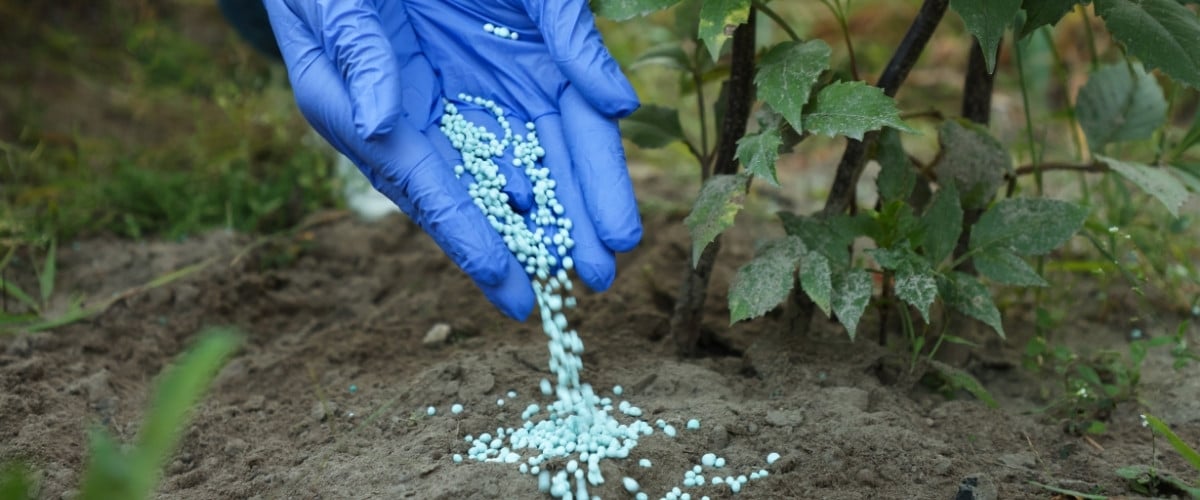
Spring tree and shrub fertilization is one of the most misunderstood services in the Vermont landscape. Walk into any garden center this time of year and you’ll see shelves of “feed your trees” products lined up next to the spring bulbs — but for most healthy trees in Chittenden County, reaching for the bag is the wrong move.
The problem is that fertilization isn’t a cure-all. Trees decline for many reasons, including soil compaction, root damage, poor planting conditions, insect activity, disease, and recurring environmental stresses like drought. Applying fertilizer without understanding what’s actually affecting the tree can waste money at best and create additional stress at worst. Before any nutrients go into the soil, an arborist should determine whether a deficiency exists and whether fertilization is likely to help.
Key Takeaways
- Healthy, established Vermont trees in good soil often don’t need supplemental spring fertilizer.
- Lawn fertilizer applied over a tree’s root zone can actually stress the tree rather than help it.
- Compacted soils in newer Chittenden County developments are where deep root fertilization most often pays off.
- Vermont’s spring fertilization window opens when soil temperatures consistently cross 40°F — typically early April to early May.
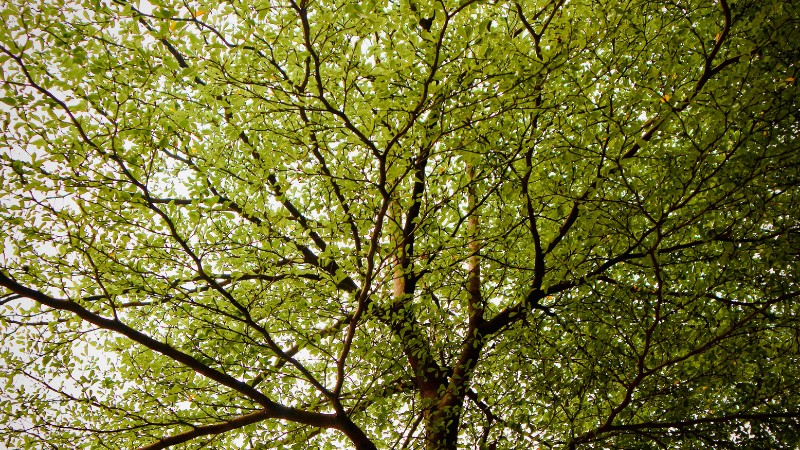
If your beech tree shows a canopy this thin, structural risk assessment becomes critical, especially if the tree is near your home, driveway, or power lines. An ISA Certified Arborist can determine whether the tree can safely support continued management or whether removal is the more prudent choice.
Do Trees Actually Need Spring Fertilizer?
Most established, healthy trees in Vermont do not need to be fertilized every spring. In a forest, trees feed themselves through decomposing leaf litter and undisturbed soil. But yard and landscape trees don’t have that advantage — they compete with turf, lose their leaf litter to fall cleanup, and grow in soil that’s often been graded or compacted.
Signs Your Tree May Benefit from Spring Fertilization
Look for these indicators that a tree might be struggling to get enough nutrients from the soil alone:
- Poor annual growth from one year to the next
- Undersized or pale leaves through the growing season
- Premature leaf drop
- Visible struggle recovering from drought, construction, or pest damage
When Fertilization Won’t Fix the Problem
Fertilization won’t help many declining trees because the underlying problem often isn’t nutrient-related. More commonly, the issue is improper watering, compacted soil, or damaged roots. Adding nutrients on top of those issues won’t fix any of them — and on a drought-stressed tree, it can make things worse. That’s why it’s always best to consult a professional Certified Arborist before deciding to buy a fertilizer and hope it works for your tree.
What’s the Difference Between Lawn Fertilizer and Tree Fertilizer?
Lawn fertilizer and tree fertilizer are formulated for completely different jobs. Using one in place of the other is one of the most common causes of unintentional damage to landscape trees. The differences show up across every major factor:
| Lawn Fertilizer | Tree Fertilizer | |
|---|---|---|
| Growth Type/Focus | Fast turf growth | Slow woody growth |
| Nitrogen Level | High, quick-release | Lower, slow-release |
| Nutrient Release | All at once, fast spike | Gradual over months |
| Effect on Trees | Weak, succulent growth | Steady, hardy growth |
Which Vermont Trees Benefit Most from Spring Fertilization?
The trees most likely to benefit share one trait: they’re growing in soils or conditions that prevent them from getting enough nutrients on their own. Four scenarios stand out in Chittenden County:
1. Mature Trees on Compacted, Disturbed Soils
Newer developments in areas like South Burlington and Williston were often built on graded subsoil where construction equipment compacted the root zone before sod was installed. That kind of soil compaction is one of the most common stress factors affecting trees in developed areas across Vermont.
Compacted soils limit oxygen, water movement, and root expansion, making it harder for trees to access nutrients naturally available in the soil. In some cases, targeted fertilization can help offset those limitations and support healthier root and canopy growth.
2. Recently Transplanted Trees (Past Year One)
First-year establishment depends almost entirely on water. Once roots have begun extending into surrounding soil, targeted fertility support can help the tree settle in.
After the initial establishment phase, moderate fertilization may encourage steady root development and improve overall vigor — especially in disturbed or low-organic soils common around new construction.
3. Trees Recovering from Documented Stress
Drought, construction damage, or pest pressure can deplete a tree’s reserves. Fertilization can support recovery once the underlying stressor is addressed — and only if the tree isn’t currently drought-stressed.
The goal is not to force rapid growth, but to help restore the tree’s energy reserves and support gradual recovery under improved growing conditions.
4. Mature Shade Trees and Ornamentals on Large Properties
Charlotte properties with established sugar maples and Shelburne landscapes with significant ornamentals often justify a targeted fertility assessment.
Large mature trees have extensive root systems and higher nutrient demands, especially in managed landscapes where leaf litter is removed, and natural nutrient cycling is reduced over time.
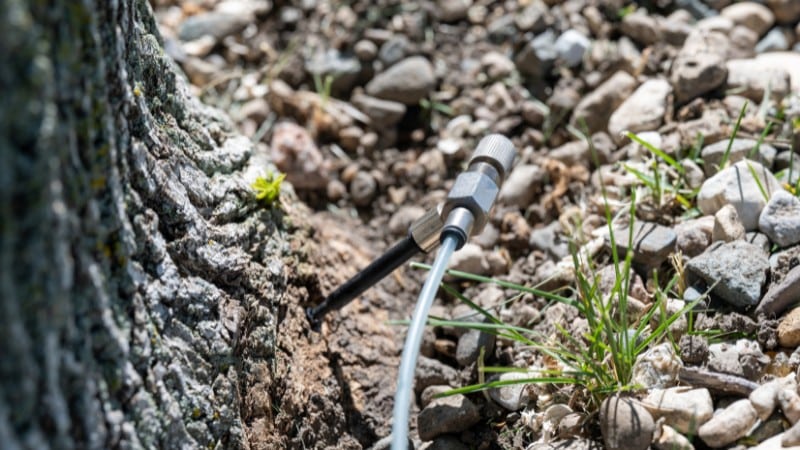
Professional soil injection targets the tree’s root system directly, providing nematode-resistance compounds and vigor-supporting amendments where they’re most effective.
What Is Deep Root Fertilization?
Deep root fertilization is a method of delivering slow-release liquid fertilizer directly into a tree’s root zone using pressurized injection. Instead of leaving nutrients at the surface — where turfgrass, thatch, and compacted soil can limit uptake — the fertilizer is applied directly into the feeder root zone where trees absorb water and nutrients most actively.
How Does Deep Root Fertilization Work?
The application is performed in a grid pattern beginning several feet from the trunk and extending outward toward the dripline. Injection points are typically spaced 18 to 24 inches apart, with nutrients delivered 4 to 8 inches below the soil surface.
This placement allows nutrients to reach the active root zone more directly than traditional surface applications, particularly in turf-heavy or compacted landscape settings.
When Is the Right Time to Fertilize Trees in Vermont?
The right time is governed by soil temperature and soil moisture, not the calendar. Tree roots resume active uptake when soil temperatures consistently cross about 40°F. In Chittenden County, that typically falls between early April and early May, varying year to year with snowmelt and soil thaw.
Applications should also be avoided during dry soil conditions or active drought stress, since trees cannot effectively use nutrients without adequate moisture.
What Happens if Trees Are Fertilized at the Wrong Time?
Timing affects both effectiveness and risk:
- Too Early (Frozen or Saturated Ground): Nutrients leach through the soil or run off.
- Too Late (After Full Leaf-Out and Active Shoot Growth): Fertilizer can encourage weak late-season growth that may not harden off before fall.
- Fall (After Leaf Drop, Before Ground Freeze): Sometimes appropriate after leaf drop and before ground freeze, but evaluated separately from spring fertilization timing.
When to Call a Professional Arborist
The decision of whether to fertilize — and how — is the part most homeowners get wrong, and it’s the part that matters most. A consulting arborist:
- Assesses the tree and the root zone in person
- Often pulls a soil sample before recommending anything
- Recommends a treatment plan only when the data supports it
- Just as often recommends watering, mulching, or addressing compaction first
Frequently Asked Questions About Spring Tree Fertilization
Can fertilization fix a tree with yellowing leaves?
Sometimes, but not always. Yellowing leaves can signal nutrient deficiency, but they can also mean compacted soil, poor drainage, root damage, or pH problems blocking nutrient uptake. A soil test tells you which one — fertilizing blind can mask the real problem.
Is organic tree fertilizer better than synthetic?
Neither is universally “better” — both work depending on the site. Organic formulations release slowly as microbes break them down. Synthetic slow-release gives predictable delivery on compacted urban soils. The right choice depends on your soil condition.
Will mulching reduce my tree’s need for fertilizer?
In many cases, yes. A proper mulch ring — 2 to 3 inches deep, pulled back from the trunk — mimics natural leaf litter. As it breaks down, it returns nutrients, improves soil structure, and reduces turf competition. Mulching well is often the highest-impact step before considering fertilization.
Should I fertilize my ash tree if it’s receiving EAB treatment?
Ask the arborist managing the treatment. An ash under active emerald ash borer treatment may be allocating energy to defense and repair, and added nutrients can either help or interfere depending on the protocol. Coordinate fertilization with the treatment plan.
Can I fertilize fruit trees the same way as shade trees?
No — fruit trees have different nutrient demands and timing tied to fruit production. Nutrient balance and application timing affect flowering, fruit set, and fruit quality. A fertilization plan for an apple orchard looks different from one for a sugar maple.
Is a soil test required before fertilization?
Not required, but it’s the difference between a guess and a plan. A soil test reveals nutrient levels, pH, and organic matter so you fertilize based on what’s actually missing. For high-value or stressed trees, it’s worth the cost.
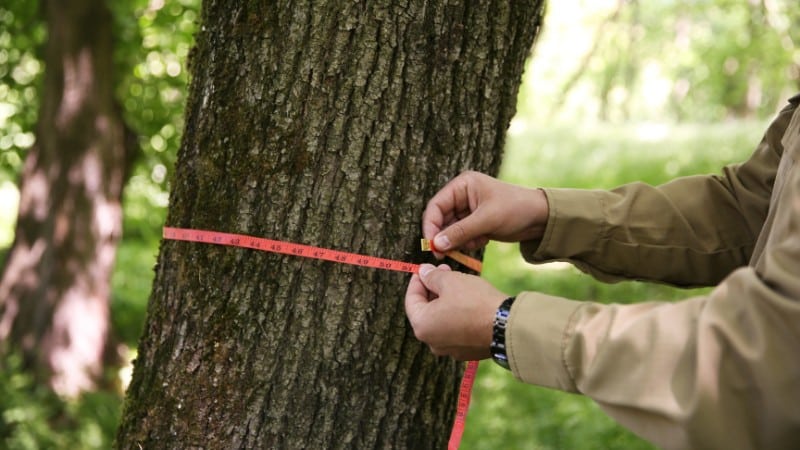
During professional evaluation, arborists assess tree diameter, overall health, dieback percentage, structural integrity, and proximity to structures—all factors that determine which treatment option (or combination) offers the best outcome for your tree and your goals.
Schedule a Spring Tree & Shrub Assessment with Teachers
Most Vermont trees don’t need routine spring fertilization — but trees growing in compacted soils, turf-heavy landscapes, or post-construction sites often benefit from a professional evaluation. The challenge is knowing when fertilization will actually help.
Teachers Tree Service has worked with Vermont landscapes since 2003, with 8 ISA Certified Arborists on staff and TCIA accreditation. Every recommendation starts with a site assessment, not a preset treatment plan. When you request a proposal, a Certified Arborist evaluates your trees and recommends what they actually need — including when fertilization isn’t the right solution.
Give us a call at 802-922-3428 or request a proposal online today to get on the schedule before the spring window closes.
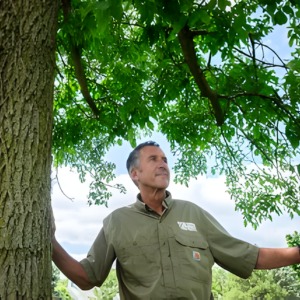
Greg Ranallo
From the classroom to the trees
Greg Ranallo has been working with trees since he was 19 years old — a passion that began long before it became a profession. After earning a master's degree in education and teaching high school social studies in his native Minnesota, Greg ultimately followed the calling he'd had since boyhood and built Teacher's Tree Service into one of the Champlain Valley's most trusted arboriculture companies. As he puts it, "I was always more a tree guy who was teaching than a teacher who did tree work."
Our Articles
Is Fall a Good Time to Plant a Tree in Vermont?
Wondering if fall is too late to plant a tree in Vermont? See the local frost timeline, best species picks, and the mistakes that kill new trees.
How Can You Tell If a Tree Is Dangerous?
Worried a tree could fall on your property? Learn the warning signs Vermont arborists check first—and when to book a hazard assessment in Chittenden County.
Why Is My Big Old Tree Dying from the Top Down?
Is your mature tree dying from the top down? The cause is almost always below ground—and often reversible when caught early. See what causes it and when to act.
