Can a Split Tree Be Saved?
Can a split tree be saved? See what a V-shaped trunk or heavy limb means, when support works, and when to book a winter risk assessment in Vermont.
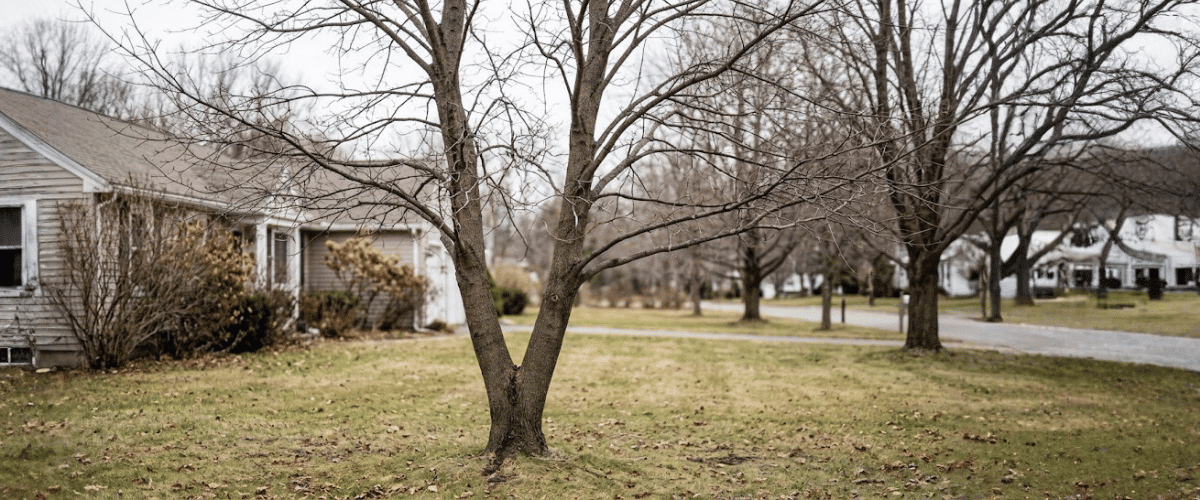
Once the leaves across Colchester, South Burlington, Williston, and Essex Junction come down, forks, long limbs, and cracks that hid under summer’s foliage become visible. If something looks off, homeowners could pose the question: Can a split tree be saved? The answer depends on how sound the surrounding wood is.
A fork or limb that held through summer storms can still come down under the wet snow and ice in Vermont, since they put the heaviest load of the year directly on these weak points. Doing something about them now is not only safer, but also less costly.
Key Takeaways
- V-shaped forks and long, heavy limbs are common failure points where trees split.
- A weak union that has not failed can often be supported, but an already-split main trunk is often a removal case.
- Arborists usually spot weak unions during a pruning or tree risk assessment visit, not from the yard.
- A winter tree risk assessment before ice builds past a quarter inch shows whether a tree needs action before that load arrives.
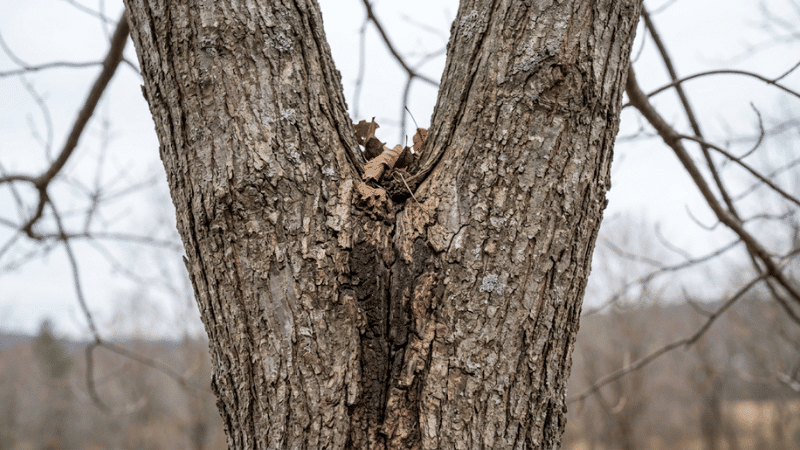
A dark line or crack where two stems meet is a defect worth having an arborist check.
Why Do Trees Split at a V-Shaped Fork?
Trees split at V-shaped forks because the attachment is weak, and a tree can look full and green while carrying that flaw. Three things explain why forks and limbs fail:
- Weak Union : Codominant stems, two of similar size meeting in a V, are common failure points, and a visible crack where the stems meet is a defect to have checked.
- Included Bark : Bark pressed between the stems makes the union significantly weaker and often shows as a dark line in the union.
- Stem or Long Limbs : Long limbs with their weight concentrated near the tips are more prone to failure.
Can You Save a Tree Trunk That Split?
Sometimes, but it depends. A few things determine the outcome:
- Location of the Split : A weak union or heavy limb that has not failed, or a union that has only begun to split, is a candidate for support. A split through the main trunk is a serious defect, and trees with unacceptable levels of risk are best removed.
- Wood Health : Decay can change the answer, so an arborist checks the wood before recommending support or removal.
- Cost and Upkeep : Support has to be reasonable compared with planting a new tree, and the owner has to be willing to schedule regular inspections.
With support, there’s an added layer of protection, but it doesn’t make a tree completely risk-free.
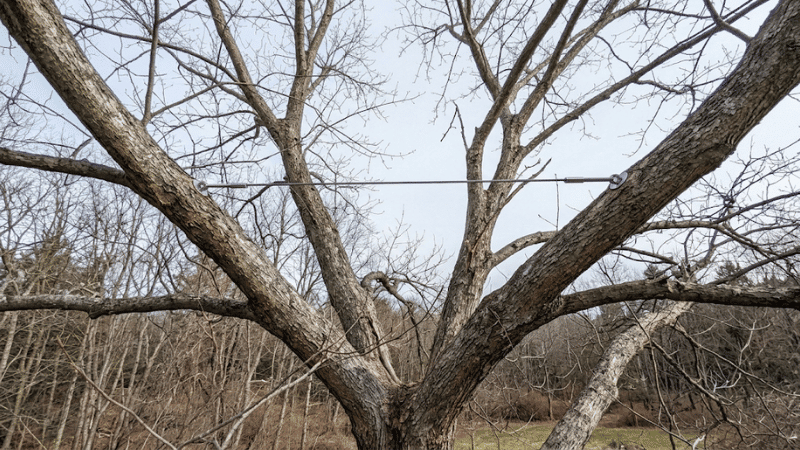
Cables shift weight from a weak union to a stronger one and limit how far a limb can move.
What Happens When an Arborist Spots a Weak Union During a Visit?
The arborist will clarify what they found and may recommend support, typically written into a proposal. During a pruning or hazard-assessment visit, Teachers Tree Service arborists check how each fork or limb attachment is holding up and how weight is distributed across the crown. That way, you don’t have to diagnose anything by yourself beforehand. Support comes in two main forms: cables (steel or synthetic) and brace rods. An arborist may recommend one or both as part of tree preservation:
- Static Cable : A flexible, extra-high-strength steel strand attached to bolts in the upper crown that shifts weight from a weak union to a stronger one and limits how far a limb can move.
- Dynamic Cable : A synthetic rope installed without drilling, used where hardware cannot go.
- Brace Rod : A threaded rod through the weak union that gives rigid support and is often combined with cables.
Before anything else, pruning is completed, then the hardware’s put in. An ISA Certified Arborist should handle the installation, since support that’s incorrectly installed can create an even bigger hazard than the one it was intended to fix. The type of support is chosen during the visit because each suits a different kind of weakness.
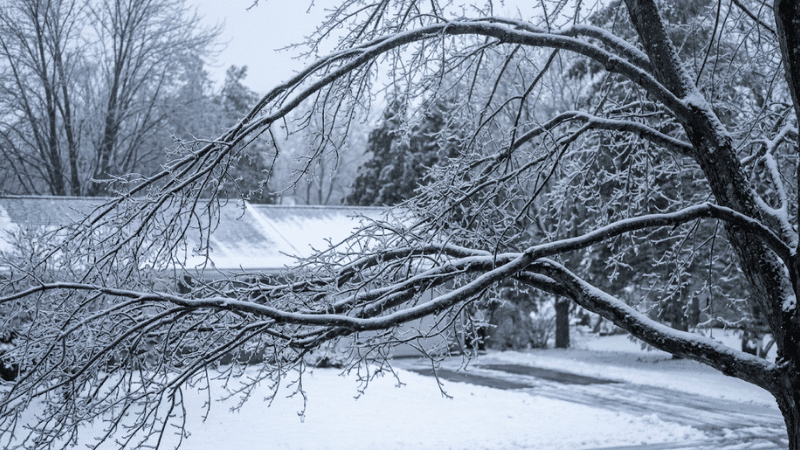
Ice and wet snow put the heaviest load of the year on weak unions and long limbs.
Why Does a Winter Tree Risk Assessment Matter in Vermont?
A winter tree risk assessment matters because ice and wet snow are what make a weak union fail, and that flaw is easier to find before winter comes. Ice buildup of about a quarter to half an inch can break small branches and weak limbs, and half an inch to an inch causes conspicuous breakage. Wet, heavy snow also weighs limbs down.
The assessment determines the likelihood of the tree failing, what it could hit, and how serious the potential consequences are. Outcomes range from structural support and targeted pruning to monitoring or removal. During the visit, ask if the union is a candidate for support, if it has sound wood, and what ongoing inspection would look like.
Some situations shouldn’t wait for an assessment and warrant prompt emergency tree service:
- Hanging Branches : Dangerous limbs that are partly broken and still overhead
- Trees on Structures : Trees or limbs on a building or blocking access
- Leaning Trees : Trees leaning against other trees
Other situations can be assessed and scheduled for a later date. Storm damage that appears to be stable still needs an expert evaluation, and an unfailed crack or split is often not an emergency as long as nothing’s shifting and nothing valuable sits underneath.
Frequently Asked Questions About Hazardous Trees
Are some trees more likely to split than others?
Yes. Trees that form narrow V-shaped crotches with included bark, such as Bradford pear, are more prone to splitting, and in one ice storm study the largest trunks suffered the most severe damage.
Can a split tree be strapped or bolted shut?
Not as a homeowner fix. Supporting a weak union is arborist work, and ISA advises leaving damaged-tree work to an ISA Certified Arborist.
How can you prevent a tree from splitting?
Prune while the tree is young: arborists remove or shorten all but one of competing stems and cut long limbs back to a secondary branch.
Do cables and braces harm the tree?
They can. Drilling for steel hardware wounds the tree and can promote discoloration and decay, especially in a tree that is already decaying, which is why arborists weigh the risk against the benefit.
How often do cables and braces need to be checked?
Hardware needs regular inspection, and Teachers Tree Service recommends a full cable and brace inspection about every five years after installation. Systems may also need replacement over time.
Let Teachers Tree Service Take a Look at Your Trees Before Winter
Getting your property looked at by an ISA Certified Arborist is the best next step. The arborists at Teachers Tree Service can check the fork, limb, and what sits underneath (e.g., a roof, driveway, or play area) before the first arrival of heavy snow. To get started, request a free proposal online for a winter tree risk assessment.
Greg Ranallo
From the classroom to the trees
Greg Ranallo has been working with trees since he was 19 years old — a passion that began long before it became a profession. After earning a master's degree in education and teaching high school social studies in his native Minnesota, Greg ultimately followed the calling he'd had since boyhood and built Teacher's Tree Service into one of the Champlain Valley's most trusted arboriculture companies. As he puts it, "I was always more a tree guy who was teaching than a teacher who did tree work."
Our Articles
Why Won’t My Shrub Lose Its Leaves in Vermont?
When a shrub won't lose its leaves while the rest of your Vermont yard goes bare, it's usually introduced buckthorn or honeysuckle. Here's how to tell which.
Is Fall a Good Time to Plant a Tree in Vermont?
Wondering if fall is too late to plant a tree in Vermont? See the local frost timeline, best species picks, and the mistakes that kill new trees.
How Can You Tell If a Tree Is Dangerous?
Worried a tree could fall on your property? Learn the warning signs Vermont arborists check first—and when to book a hazard assessment in Chittenden County.
